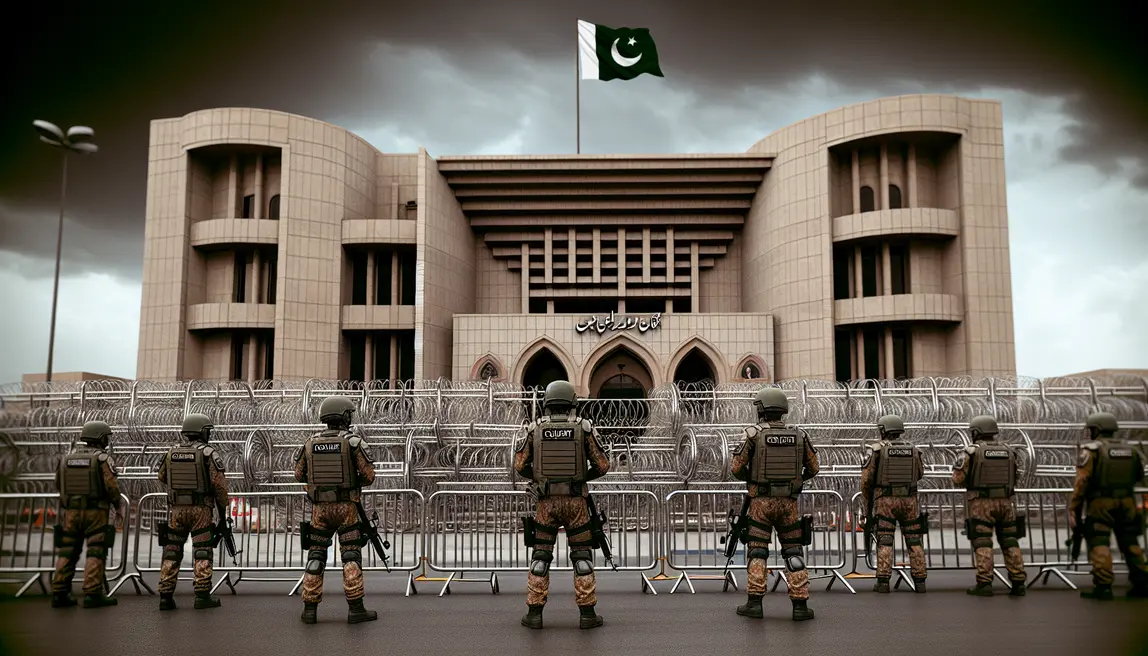
Pakistan is witnessing an unprecedented tightening of its legal grip on political dissent, particularly targeting former Prime Minister Imran Khan and prominent activists. This intensified crackdown marks a pivotal moment in the ongoing struggle between state control and democratic freedom. The government’s justification hinges on national security concerns, yet critics argue that such actions severely curtail freedom of expression and political opposition in a country already grappling with deep military influence. The arrest and seclusion of political figures underscore a broader pattern of silencing dissent under the guise of constitutional law enforcement, casting a shadow over Pakistan’s democratic future.
Background & Context: The Bigger Picture of Pakistan Political Dissent
Pakistan’s complex political landscape has been historically marked by an uneasy balance between civilian governments and military influence. Since its inception, the nation has experienced multiple military coups that have interrupted democratic processes. The current crackdown on political dissent must be viewed against this backdrop of recurring power struggles. The former prime minister Imran Khan, a popular but controversial figure, has become emblematic of resistance against entrenched political and military establishments.
Pakistan’s legal framework, particularly the Prevention of Electronic Crimes Act (PECA), plays a crucial role in this context. Originally intended to regulate cybercrimes, PECA has increasingly been employed to restrict digital free speech and silence government critics. The recent sentencing of human rights lawyer Imaan Mazari and her husband illustrates how these laws extend beyond conventional political dissent to include activists and legal professionals. These developments align with a global pattern where authoritarian regimes manipulate national security laws to suppress opposition voices.
Detailed Analysis: The Legal Offensive Against Dissent
The legal offensive against Imran Khan exemplifies the government’s approach to controlling political narratives that challenge state authority. Restrictions placed on Khan include the suspension of prison visits, a move justified by allegations that he violated jail rules by engaging in political activities and spreading anti-state messages. Despite government assurances that Khan receives privileged treatment with access to facilities like gym equipment and a personal cook, the suspension of visits effectively isolates him and curtails his influence.
This tactic is mirrored in the case of Imaan Mazari and her husband, convicted and sentenced to 10 years under charges related to sharing content deemed anti-state on social media. Prosecutors accuse them of disseminating narratives aligned with hostile terrorist groups, a charge that conflates political criticism with threats to national security. Such legal interpretations not only criminalize dissent but also instill a chilling effect across the wider activist community.
Officials insist that these measures are legal and necessary to safeguard public order and national security. Interior Minister Talal Chaudhry stated emphatically that attempts to frame these actions as suppression of democracy or human rights are “entirely misplaced.” Meanwhile, military spokespersons stress constitutional adherence and dismiss allegations of undue interference in political affairs. However, the convergence of civilian and military powers in these decisions raises concerns about the dilution of democratic institutions.
Expert Perspectives: Voices from Officials and Critics
“The civilian government is taking decisions. We are all working hand in glove,” Interior Minister Talal Chaudhry said in defense of the government’s stance, highlighting the synergy between civilian authorities and the military leadership.
Security officials emphasize the threat posed by certain political narratives that they argue could destabilize the country if allowed to spread unchecked. They contend that convicted politicians like Khan using incarceration periods to mobilize opposition cross a line into threats to national defence.
Conversely, human rights advocates and political analysts perceive this narrative as a pretext to suppress legitimate political dissent. They warn that Pakistan’s democratic space is rapidly shrinking under increasing military shadow. The punishment of lawyers and activists sends a message that not only political figures but also those who defend civil liberties risk persecution.
For further insights into Pakistan’s political dynamics and military influence, readers can refer to Council on Foreign Relations analysis on Pakistan’s civil-military relations.
Implications & Impact: Who is Affected and How
The clampdown on Pakistan political dissent has profound implications for multiple sectors. Politically, silencing opposition leaders like Imran Khan erodes democratic competition and could entrench authoritarian tendencies. For civil society, the criminalization of dissent through the judiciary signals a shrinking space for activism and opposition voices.
Internationally, these actions may affect Pakistan’s diplomatic relationships, especially with democratic nations that prioritize human rights and rule of law. The use of laws like PECA against journalists and activists has drawn criticism from global watchdogs such as Human Rights Watch.
For the average Pakistani, the consequences are significant. Restrictions on free expression, political participation, and legal representation diminish public trust in institutions and discourage civic engagement. The isolation of key political figures also risks destabilizing social and political cohesion.
Historical Context & Precedents: Patterns of Suppressing Dissent in Pakistan
Pakistan’s recurring military interventions have set a precedent for the suppression of political dissent, dating back to the first coup in 1958. Subsequent decades witnessed martial law periods, censorship, and political imprisonments that became tools for military rulers to consolidate power.
The 1990s saw similar crackdowns during civilian governments, but the military’s influence often loomed behind the scenes, shaping political outcomes. Today’s intensified restrictions reflect an evolution of these tactics, with legal frameworks and cyber laws being newer instruments used to silence dissent.
This trend is not unique to Pakistan; many countries have adopted similar strategies, responding to political dissent with legal and security measures rather than open political dialogue.
Future Outlook & What’s Next for Pakistan Political Dissent
Looking ahead, Pakistan’s political landscape faces uncertainty. The government’s robust legal stance may deter public dissent in the short term but risks deeper societal fractures long term. Observers predict potential escalations in political tensions, especially if opposition voices are further marginalized.
Reform advocates call for safeguarding independent judiciaries and ensuring that laws like PECA are not misused to stifle free speech. International pressure and engagement could play a role in incentivizing the Pakistani government to uphold democratic norms.
For an ongoing evaluation of digital rights and political repression, the Access Now digital rights reports on Pakistan provide credible and updated information.
Conclusion: Pakistan’s Democratic Challenge in the Face of Political Repression
The escalating suppression of dissent in Pakistan, underpinned by stringent legal measures against political leaders and activists, signals a critical juncture for the country’s democracy. While framed as necessary for national security, these moves threaten to erode fundamental freedoms and deepen military influence over civilian affairs.
Understanding this dynamic is crucial for those monitoring democratic development and human rights in South Asia. As Pakistan navigates these turbulent waters, the balance between security and freedom remains delicate, with significant consequences for its people and international relations.
For more updates on pakistan political dissent, stay tuned to our latest coverage.
About The Author