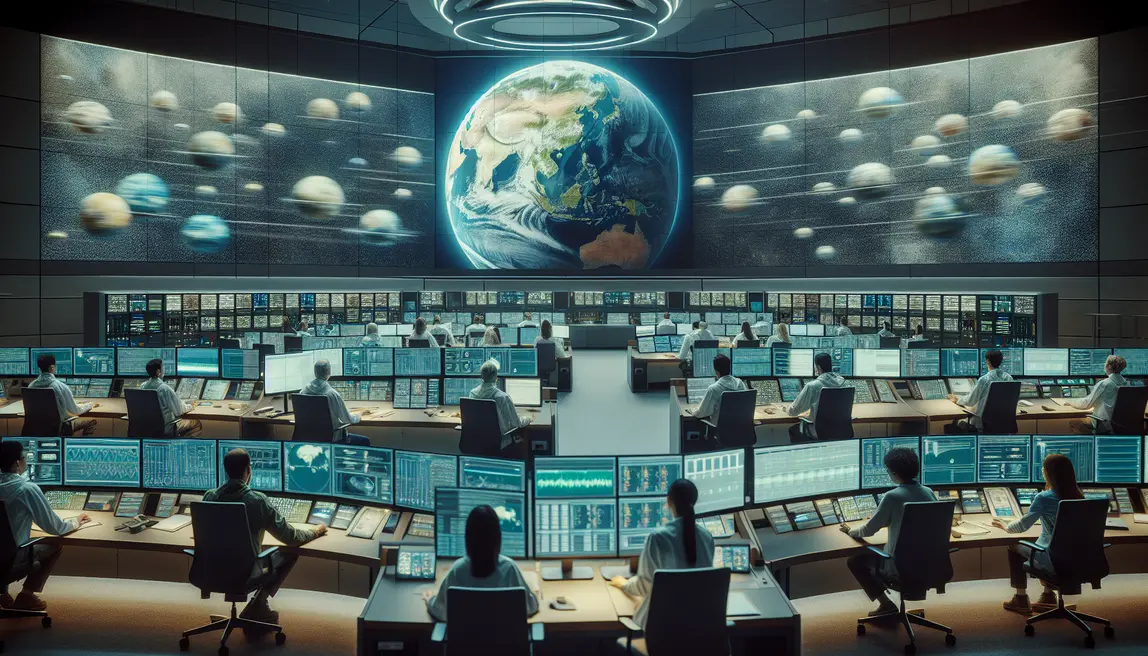
As the year 2026 approaches, a viral theory alleging that Earth will lose its gravity for a brief period in August has captured widespread attention and sparked panic across social media. Centered around a purported leaked NASA document titled “Project Anchor,” this claim predicts catastrophic consequences including mass casualties, geological upheaval, and atmospheric collapse. However, NASA has firmly debunked this notion, clarifying fundamental misunderstandings about gravity and Earth’s physical properties. In this investigative feature, we delve deep into the origin of this viral claim, examine the scientific truths behind gravity, and explore why the “earth gravity 2026” theory is unfounded yet has managed to gain traction worldwide.
Background & Context: Understanding Gravity and Viral Misinformation
Gravity, a fundamental force of nature, is the attractive force between masses. In Earth’s case, it is determined by the planet’s mass and the universal gravitational constant. This force keeps everything anchored, from oceans to the atmosphere and all living beings. The conspiracy theory in question alleges a seven-second loss of this force on August 12, 2026, coinciding with a total solar eclipse occurring that same day.
The viral narrative alleges that this anomaly is linked to a secret NASA project dubbed “Project Anchor,” supposedly leaked in November 2024. The claim states that Earth’s gravity will temporarily “switch off,” causing devastating effects such as billions of dollars in damage, 40 million deaths, and societal collapse. Videos and social media posts have shared fragmented clips of a 2020 YouTube video from the science channel What If, which contemplates a hypothetical scenario where gravity suddenly disappears.
This misinformation highlights the growing trend of viral panic fueled by misunderstanding scientific phenomena, compounded by the rapid spread of content on platforms like TikTok and YouTube.
Detailed Analysis: Why Earth Losing Gravity in 2026 Is Impossible
The key to debunking the “earth gravity 2026” claim lies in basic physics and planetary science. Gravity on Earth is directly linked to its mass — the combined mass of its core, mantle, crust, oceans, atmosphere, and terrestrial water. To “lose” gravity, Earth would have to lose a substantial portion of its mass instantaneously, which is scientifically untenable.
The viral theory also erroneously links gravity loss to the total solar eclipse on August 12, 2026. While eclipses influence tidal forces through the gravitational pull of the Moon and Sun, these tidal effects do not equate to an overall loss of gravity. The gravitational force exerted by Earth remains stable and predictable, unaffected by eclipses. These scientific facts are supported by decades of astronomical and geophysical research.
Furthermore, the imagined consequences described in the viral videos — from sudden levitation of objects and people to rapid atmospheric escape and geological catastrophes — are rooted in a thought experiment meant solely for exploration of “what-if” scenarios. The original content in the What If science channel explicitly highlights the speculative nature of this scenario, not as a realistic forecast.
Expert Perspectives: NASA’s Definitive Rebuttal and Scientific Insight
“The Earth will not lose gravity on Aug. 12, 2026. Earth’s gravity, or total gravitational force, is determined by its mass. The only way for the Earth to lose gravity would be for the Earth system to lose mass,” said a NASA spokesperson in an email response to Snopes.
NASA has categorically rejected the existence of any project named “Project Anchor” or any plans involving an $89 billion budget allocation to manage gravity changes, labeling such rumors as baseless. Additionally, experts affirm that gravitational forces from celestial bodies such as the Moon and Sun affect tides but do not cause interruptions or anomalies in Earth’s intrinsic gravity. This is backed by data from institutions such as the National Aeronautics and Space Administration and the U.S. Geological Survey, which monitor Earth’s geophysical parameters continuously.
Implications & Impact: Why the Viral Claim Matters to You
Though scientifically unfounded, the spread of the “earth gravity 2026” claim illustrates how misinformation can provoke public anxiety and distract from real scientific literacy. It underscores the importance of critical thinking and evaluation of sources, particularly on social media.
Understanding gravity is not just academic; it affects technologies reliant on Earth’s gravitational field, including satellite navigation systems, geophysical surveys, and climate models. Misinformation about such fundamental forces can erode trust in scientific institutions and cause unwarranted fears, thus impacting public perception and response to real environmental or technological challenges.
Historical Context: Viral Scientific Myths and Public Reaction
This is not the first time a viral myth related to Earth’s natural forces has circulated widely. Historical examples include panic around Y2K, the 2012 Mayan calendar apocalypse, and recent concerns over electromagnetic storms affecting the planet. Often, these narratives emerge around real astronomical or environmental events but are distorted by incomplete understanding and sensationalism.
Such phenomena underscore the role of science communication and public education in combating misinformation and fostering an informed public. Agencies like ScienceDaily and National Geographic Science continue efforts to provide accessible and accurate scientific explanations to the public.
Future Outlook & What’s Next for Earth Gravity 2026 Claims
As August 2026 approaches, it is anticipated that similar claims might resurface and evolve, fueled by social media algorithms that prioritize sensational content. It remains crucial for credible scientific organizations and media outlets to proactively address these claims with factual information.
Efforts to improve scientific literacy through education, public engagement, and transparent communication of studies related to Earth sciences and astronomy will help mitigate the impact of such misinformation. Observing how information spreads and correcting misconceptions quickly will be keys to preserving public trust.
Conclusion: Separating Fact from Fiction on Earth Gravity in 2026
The viral claim that Earth will lose gravity in 2026 is a scientifically baseless conspiracy theory fueled by misunderstandings of physics and sensational social media content. NASA’s clear and authoritative rebuttal confirms that Earth’s gravity is governed by its mass and cannot simply “switch off” even momentarily.
For readers, this episode serves as a crucial reminder to critically evaluate extraordinary claims, seek information from verified scientific sources, and understand the fundamentals of natural phenomena. Awareness, combined with reliable scientific communication, remains the best defense against viral misinformation.
For those curious about the real impact of the upcoming solar eclipse and the nature of gravity, we encourage visiting reputable astronomy and science education sites like those of the NASA Eclipse Web Site and physics resources such as LIGO Caltech’s gravity explanations.
For more updates on earth gravity 2026, stay tuned to our latest coverage.
About The Author