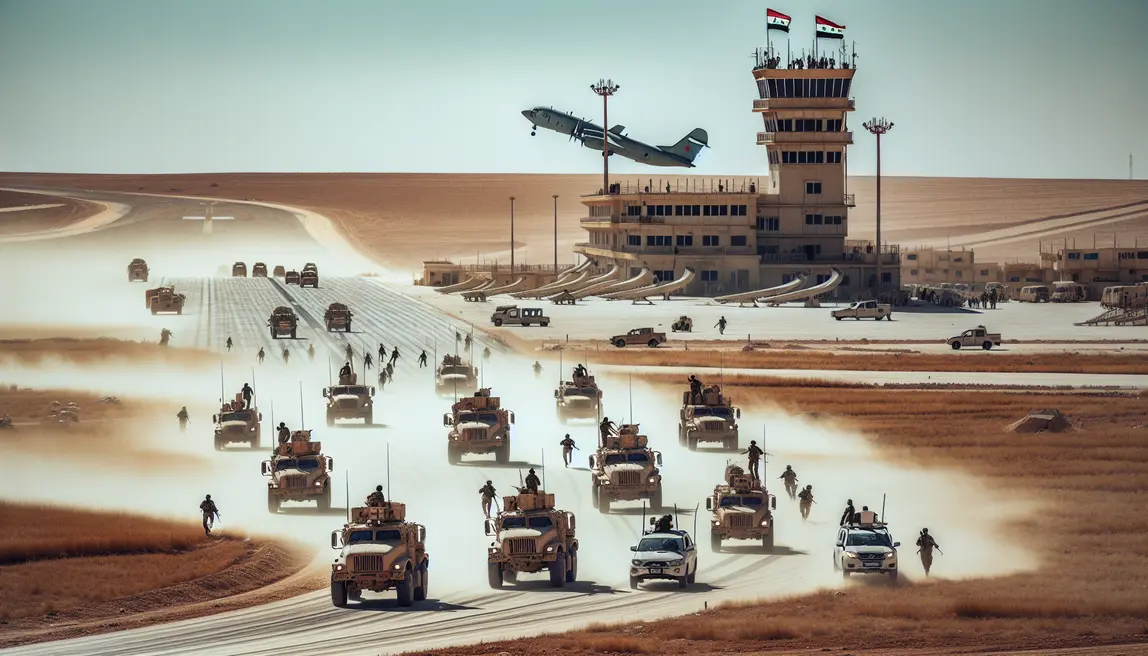
The recent advance of the Syrian army into Kurdish-held territories marks a significant turn in the ongoing syria kurdish conflict. On January 18, 2026, government forces seized control of the strategically crucial Tabqa military airport in Raqqa province — a key victory that signals a shift in power dynamics within northern Syria. This development not only exacerbates tensions between Damascus and Kurdish factions but also threatens to destabilize the fragile geopolitical balance that has existed since the end of Syria’s civil war in 2024. Understanding the wider context and implications of this advance is essential for comprehending the complex landscape of Middle Eastern security and its global repercussions.
Background & Context of the Syria Kurdish Conflict
The syria kurdish conflict is rooted in decades of ethnic, political, and territorial disputes that intensified during Syria’s devastating civil war. Kurdish groups, primarily the Syrian Democratic Forces (SDF), emerged as key players in northern and northeastern Syria, carving out semi-autonomous zones governed by Kurdish-led administrations. Their alliance with the United States, particularly in the fight against the Islamic State group, bolstered Kurdish military and political standing in the region.
The city of Raqqa gained global notoriety during the Islamic State’s occupation starting in 2014, symbolizing the brutal jihadi regime’s self-proclaimed caliphate. The US-backed SDF liberated Raqqa after a punishing campaign that dealt severe infrastructural damage, and since then, Kurdish forces have maintained control, supported by a small American military presence.
However, the removal of Bashar al-Assad from power in 2025 and the subsequent rise of the rebel coalition led by President Ahmad al-Sharaa created a volatile environment. Kurdish authorities have shown reluctance to integrate their military and civilian structures into the post-war Syrian government, fearing loss of autonomy and mistrust towards Damascus. The tenuous political arrangement has been fragile, with efforts at negotiation often stalling under the weight of competing interests.
Detailed Analysis of the Recent Military Advance
On January 17-18, 2026, Syrian government forces launched a carefully coordinated offensive into Kurdish-held northern Syria, capturing multiple towns and the vital Tabqa military airport. This airport serves as a strategic asset for controlling transport and surveillance in Raqqa and nearby oil-rich regions, making it a significant prize in the broader conflict.
The offensive followed weeks of escalating clashes between the Syrian army and SDF. The government’s capture of Tabqa is not merely a tactical victory but a symbolic assertion of Damascus’s intent to reestablish authority over Kurdish-held areas. It came shortly after Kurdish fighters retreated east of Aleppo, responding to a decree by President al-Sharaa affirming Kurdish rights — a gesture meant to ease mounting tensions that instead sparked more violence.
The situation rapidly deteriorated as both sides accused each other of violating ceasefire terms, leading to intensified fighting that has resulted in at least 24 civilian fatalities and displaced thousands. The US military, wary of the conflict’s escalation, has issued calls for restraint. Adm. Brad Cooper, head of US forces in the Middle East, urged Damascus to halt offensive actions, underscoring Washington’s concern over losing leverage and risking a resurgence of ISIS.
Expert Perspectives on the Syria Kurdish Conflict
“The seizure of Tabqa military airport marks a pivotal moment in Syria’s attempts to consolidate control after years of fractious civil war and Kurdish autonomy. Washington’s backing of Kurdish forces complicates this scenario, as American troops are now in the precarious position of balancing counter-terrorism objectives with the realpolitik of regional power struggles.” — Dr. Leyla Hassan, Middle East Security Analyst
“The Kurdish administration’s hesitation to fully integrate with the new Syrian government reflects deep-seated fears and mistrust born from past conflicts and marginalization. The conflict’s recent flare-up could either force a renewed political dialogue or result in a prolonged, destabilizing struggle that jeopardizes peace efforts in the broader region.” — Prof. Samuel Klein, International Relations Expert
Implications & Impact of the Government’s Advance
The Syrian army’s gain in Kurdish territories is poised to affect multiple stakeholders, locally and internationally. For Kurdish civilians and fighters, this translates to a loss of control over their self-administered areas, heightening fears of repression and diminished political rights despite the presidential decree promising protections.
Regionally, this escalation threatens to reignite broader conflicts within Syria and strain relations with neighboring countries with vested interests. The US presence in Syria, primarily for counterterrorism and to curb ISIS activity, faces increased risk, prompting urgent diplomatic engagement, including envoy meetings in northern Iraq with Kurdish leaders.
The possibility of a protracted conflict raises concerns about a potential humanitarian crisis, with civilian casualties and displacement expected to rise. Moreover, the fighting jeopardizes ongoing international efforts to stabilize Syria and prevent the resurgence of extremist groups, as control over critical infrastructure and oil fields shifts hands.
Historical Context and Precedents
The syria kurdish conflict is not an isolated event but part of a long history of Kurdish struggles for autonomy across the Middle East, spanning Syria, Turkey, Iraq, and Iran. Past episodes, such as the Kurdish uprisings in the 1980s and control of enclaves during the Syrian Civil War, provide a nuanced backdrop to current developments.
The 2024 overthrow of Bashar al-Assad marked a seismic shift, ending Syrian state control that had lasted for decades and ushering in a new political order. However, the unresolved Kurdish question remains a critical challenge, as it intertwines with regional geopolitical interests, ethnic identity, and the aftermath of a brutal civil war.
Future Outlook & What’s Next
Looking ahead, the trajectory of the syria kurdish conflict hinges on diplomatic negotiations and military maneuvers alike. Key issues include the integration of Kurdish forces into national military structures, guarantees for Kurdish political rights, and the role of international actors like the US, Russia, and regional powers.
Efforts to prevent further bloodshed will require sustained dialogue and confidence-building measures. However, the recent clashes underscore the fragility of the current peace and the potential for the conflict to escalate, risking wider instability that could reverberate across the Middle East.
For comprehensive insights into the conflict’s developments and international perspectives, readers can consult sources such as the United Nations Security Council updates, Council on Foreign Relations Syria Conflict Analysis, and BBC Middle East Coverage.
Conclusion
The Syrian army’s capture of the Tabqa military airport signifies a crucial development in the ongoing syria kurdish conflict, challenging the tenuous equilibrium established after years of civil war. This escalation highlights the complex interplay of ethnic autonomy, national sovereignty, and international involvement shaping Syria’s future.
For observers and policymakers alike, the immediate task is to monitor the evolving situation closely — recognizing that the resolution or exacerbation of this conflict will profoundly affect regional stability, international security, and the lives of countless civilians caught in its wake.
For more updates on the syria kurdish conflict, stay tuned to our latest coverage.
About The Author